
One Consciousness
CONSCIOUSNESS
The Illusion of Separation and Returning the Light Back to Its Source
Introduction
In the modern era, an estimated 99% of humanity operates in a state of profound somnambulism—a hypnotic trance characterized by the unquestioned acceptance of a strictly material, fragmented reality.
In this state, individuals perceive themselves as isolated entities, fragile biological accidents adrift in an indifferent and often hostile universe. This illusion of separation forms the bedrock of all human suffering, generating the fear of death, greed, conflict, and the incessant pursuit of external validation. The contemporary world is structured much like a Monopoly board—a closed economy governed by artificial rules, debts, and arbitrary chance, where the players have entirely forgotten that they are also the architects who boxed the game.
However, hidden beneath the veneer of this localized, material experience lies a radical and unifying truth that has been preserved across millennia by esoteric traditions, mystics, and, increasingly, by the bleeding edge of quantum physics and analytical philosophy. This truth asserts that there is only one infinite source of consciousness, an intelligent and living primordial energy that comprises the entirety of existence. There is no “creator” and “creation” as separate entities; there is only the One playing an elaborate cosmic game of hide-and-seek with itself. Every human being, every star, and every atom is a localized fractal of this singular consciousness, experiencing reality from billions of unique perspectives simultaneously.
This comprehensive report explores the profound mechanics of this unified reality. By synthesizing the ancient wisdom of Gnosticism, the non-dualistic poetry of Jalal ad-Din Muhammad Rumi, the psychological dismantling of the ego by Alan Watts and Eckhart Tolle, and the metaphysical mechanics of conscious manifestation, this analysis aims to map the topology of existence. It provides a definitive guide for awakening from the collective hallucination of the material “Matrix,” reclaiming energetic sovereignty, and mastering the art of the conscious creator.
The One Source: The Physics and Philosophy of Unity
To comprehend the nature of reality, one must discard the anthropomorphic projections of conventional religion, which often depict a distant, judgmental deity residing in the sky. The “God” of true metaphysics is not a person but a unified field—the background energy of the universe, a silent fullness of pure potentiality that the ancients called Intelligent Infinity, the Tao, or Brahman.
The separation perceived by the physical senses is a functional necessity for localized experience, but it is fundamentally illusory. The divine is not distant; it is the very substrate of human awareness. Erwin Schrödinger, one of the founding fathers of quantum mechanics, noted after immersing himself in the non-dual philosophy of Advaita Vedanta:
"The total number of minds in the universe is one. In fact, consciousness is a singularity phasing within all beings."
The observable universe is not a dead, mechanical machine made of atoms and molecules; it is a mental projection.
Analytic Idealism: Dissociation in the Cosmic Mind
Modern philosophy, particularly the framework of Analytic Idealism championed by Bernardo Kastrup, provides a rigorous ontological model for this ancient truth. Analytic Idealism posits that the only fundamental reality is “Mind at Large”—a single, universal field of experiential consciousness. Matter is not a separate substance; rather, the physical universe is simply what the thoughts and emotions of the universal mind look like when viewed from the outside.
If there is only one mind, why do humans experience isolated, private inner lives? Kastrup answers this using the psychological mechanism of dissociation. Just as a patient with Dissociative Identity Disorder (DID) can split their psyche into multiple, mutually unaware “alters,” Mind at Large has dissociated into billions of localized alters.
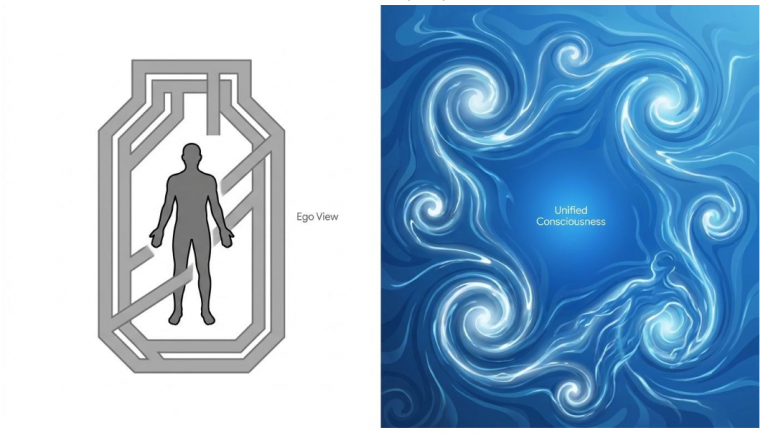
Every living organism is a dissociated alter of the cosmic consciousness. The physical body and brain do not generate consciousness; they are merely the extrinsic appearance of the dissociative boundary—a reducing valve or filter that constrains universal awareness into a narrow, survival-oriented perspective.
Alan Watts and the Hoax of the Ego
The British philosopher Alan Watts extensively documented the mechanisms through which society enforces this dissociative boundary. In his seminal work, The Book: On the Taboo Against Knowing Who You Are, Watts argues that the most intensely policed taboo in human culture is the prohibition against realizing one’s fundamental unity with the cosmos.
Watts deconstructed the prevailing hallucination of the self as a “separate ego enclosed in a bag of skin”. Western civilization, he argued, operates on a “Fully Automatic Model” of the universe, wherein intelligent life is viewed as an accidental byproduct of a blind, mechanical void. This worldview implants a profound sense of alienation, prompting humanity to fight against nature rather than recognize itself as an expression of it. Watts noted,
"We do not 'come into' this world; we come out of it, as leaves from a tree."
This illusion of separateness is maintained through a societal “double-bind”. Children are simultaneously ordered by society to be free, independent agents while being rigorously compelled to conform. This contradiction solidifies the ego, a term derived from the Latin persona, meaning the theatrical mask through which an actor’s voice sounds. The ego is not a tangible entity; it is a performed role, a hoax that humanity has been hypnotized into taking seriously.
To break this hallucination, Watts urged individuals to see the universe not as a battlefield of isolated parts, but as a system of profound biological and geological cooperation. The perception of distinct “things” and “events” is merely a cognitive bias, much like looking at a cat through a narrow slit in a fence: the head appears first, followed by the tail, leading the observer to falsely conclude that the head “caused” the tail, when in fact they are one continuous organism. Watts asserted that life must be lived in the spirit of the Hindu concept of lila (cosmic play), recognizing that the ultimate “I” is the entire process of existence playing a game with itself.
The Necessity of Duality: Light, Dark, and the First Distortion
If the One Source is perfect, eternal, and omnipotent, why would it choose to fragment itself into billions of ignorant, suffering pieces? The esoteric answer is as simple as it is terrifying: to know itself.
In a state of absolute, static perfection, the Infinite is alone. It cannot experience its own infinity because there is no contrast; a subject cannot observe itself without an object, and light cannot know its brilliance without the existence of darkness. To transform abstract potentiality into manifest experience, the One induced a state of voluntary amnesia. It shattered into the multiplicity of the cosmos, putting on the “masks” of billions of humans, animals, and objects.
The Law of One (the Ra Material)—a highly complex metaphysical cosmology detailing the evolution of consciousness across seven “densities”—answers this through the mechanics of polarity. The Infinite Source established a primary rule before creating the cosmos: the law of Free Will, also known as the First Distortion. Free Will dictates that every fractal of consciousness has the absolute, irrevocable right to choose its orientation.
To have a genuine choice, there must be authentic options. Therefore, the universe birthed duality. Love in a void is invisible; to experience the profound depth of love, the creator had to construct an environment where fear, separation, and hatred were deeply convincing possibilities. This required the installation of the “Veil of Forgetting,” an energetic membrane that blocks the conscious mind from remembering its divine origins upon incarnating in the third density (Earth).
Without this amnesia, humans would be playing a video game with “God Mode” activated. If one knows they are immortal and that all beings are merely themselves in disguise, the choice to act with love carries no weight or risk. The Veil makes the physical world feel terrifyingly real, ensuring that when an individual chooses compassion in the face of apparent hostility, the choice is authentic, thereby generating immense evolutionary voltage. Suffering is not divine punishment; it is the necessary friction that polishes the soul, pushing it to polarize toward either Service to Others (the path of unity and radiation) or Service to Self (the path of separation and absorption).
Gnosticism: The Epistemic Science of Awakening
To understand how the illusion of separation is structurally enforced, one must examine the ancient metaphysical framework of Gnosticism. Historically, Gnosticism is often misunderstood merely as a heretical sect of early Christianity. In reality, it is not a religion based on belief; it is a spiritual technology and a path of direct experiential knowledge.
The etymological root of Gnosticism is the Greek word gnosis, meaning direct, transformative inner knowledge, which stands in stark contrast to pistis (blind faith or belief). Orthodox religions demand belief in an external God, mediated by priests, scriptures, and institutions. Gnosticism inverts this dynamic entirely: it posits that there is no external “god” to pray to. Instead, the ultimate reality is the One Source of consciousness, and the goal of human existence is to awaken to the realization that the deepest self (the Divine Spark) and the Source are identical.
Divergent Paradigms: Orthodox Religion vs. The Gnostic Path
| Dimension | Conventional Religion | Gnosticism |
|---|---|---|
| Primary Act | Requires faith (pistis) and participation in exoteric communal worship. | Demands knowledge (gnosis) and personal, esoteric spiritual enlightenment. |
| Direction of Practice | Outward submission to creeds, sacraments, and doctrinal uniformity. | Inward exploration guided by mystical insight and self-knowledge. |
| Authority / Mediator | Relies on ecclesiastical authority (clergy/bishops) as custodians of revealed truth. | Emphasizes direct, unmediated access to the Divine through one’s own inner vision. |
| Ultimate Goal | Salvation attained through divine grace and faith in Christ’s sacrificial atonement. | Spiritual liberation of the divine spark from the material prison. |
| View of the Material World | Viewed as intrinsically good, representing a deliberate creation by a perfect God. | Viewed as a flawed prison, fashioned by an ignorant or malevolent Demiurge. |
While conventional religion requires outward submission to an external deity, Gnosticism operates as an epistemic discipline requiring inward exploration to realize the unity between human consciousness and the Absolute Source. Data sources: Philoparadoxia, Awka Times. Cosmic Core
The Cosmogony of the Prison and the Pearl
Gnosticism provides a robust, allegorical blueprint of the universe, popularized by texts discovered in the Nag Hammadi library in 1945 by an Egyptian farmer named Muhammad Ali al-Samman. These texts, which orthodox heresiologists like Irenaeus sought to destroy, outline a profound cosmology:
- The Monad and the Pleroma: The ultimate reality is the Monad (The Invisible Spirit), an ineffable, perfect source of light. From the Monad emanate various divine attributes called Aeons, which together comprise the Pleroma (the Fullness of the divine realm).
- The Fall of Sophia: The cosmic rupture occurred when Sophia, the Aeon representing Wisdom, desired to comprehend the Monad or create without her divine consort. Her passionate, unauthorized action produced a flawed, aborted emanation that was cast out of the Pleroma.
- The Demiurge (Yaldabaoth): This flawed offspring is the Demiurge, a blind and arrogant creator-god. Ignorant of the higher divine realms, the Demiurge declared himself the only god and fashioned the material universe. Thus, to the Gnostics, the physical world is not a divine paradise but a compromised matrix or prison.
- The Divine Spark: To animate his material creations (humanity), the Demiurge was tricked into breathing the stolen light of Sophia into them. Consequently, human beings are dualistic creatures: they possess a physical body bound to the Demiurge’s laws, but they carry within them a “Divine Spark”—a literal fragment of the highest Pleroma.
The Texts of Knowledge: Nag Hammadi's Legacy
The Nag Hammadi discovery offered unparalleled insight into how the Gnostics practiced this philosophy. The collection includes several key texts that emphasize internal realization over external dogma:
| Text | Gnostic Tradition | Core Metaphysical Focus |
|---|---|---|
| The Secret Book of John | Sethian | Provides the definitive cosmology of the Monad, the emanation of Aeons, the fall of Sophia, the creation of the Demiurge (Yaldabaoth), and the trapping of the divine spark in humanity. |
| The Gospel of Thomas | Proto-Gnostic / Sayings | Contains 114 cryptic sayings of Jesus. It lacks any narrative of the crucifixion or resurrection, focusing entirely on discovering the Kingdom of God within the self. |
| The Gospel of Truth | Valentinian | A poetic homily that describes existence without Gnosis as a nightmare of ignorance. It portrays Jesus as a guide who awakens humanity to the knowledge of the Father. |
| The Gospel of Philip | Valentinian | Emphasizes the reunification of divided spiritual elements (Syzygy) and describes sacraments, such as the “bridal chamber,” as metaphors for attaining divine unity. |
The Gospel of Thomas explicitly rejects the orthodox idea of an apocalyptic, future Kingdom of Heaven. In Saying 3, Jesus states:
"If your leaders say to you, 'Look, the kingdom is in the sky,' then the birds of the sky will precede you... Rather, the kingdom is inside of you and outside of you. When you come to know yourselves, then you will be known, and you will realize that you are the children of the living Father. But if you do not know yourselves, then you live in poverty, and you are the poverty."
This encapsulates the Gnostic mandate: salvation is self-realization. To remain ignorant of the Divine Spark is to be complicit in one’s own imprisonment. The Demiurge and his Archons (the psychological wardens or “egregores” of the system) feed on the dense emotional energy of humanity—fear, anger, and suffering. By achieving Gnosis and recognizing the illusion of the material world, the individual cuts the energetic feeding tube, reclaiming sovereignty and starving the Archontic system.
The Eternal Now: The Illusion of Time and Eckhart Tolle
One of the most rigid bars in the prison of the Matrix is the human perception of linear time. Humanity conceptualizes time as a straight line (Chronos) running from the past, through the fleeting present, into an uncertain future. This engenders relentless anxiety, regret, and the paralyzing fear of death.
The spiritual teacher Eckhart Tolle centers his teachings on dismantling this illusion. Tolle argues that the ego is a relentless, noisy mechanism of the mind that continuously projects itself into the past through grievance and into the future through anxiety. The ego requires time to survive; it cannot exist in the pure presence of the “Now”. The path to realizing one’s unity with the Source requires detaching from this egoic timeline. By becoming the “silent watcher”—the observer of one’s own thoughts—the individual realizes they are not the voice speaking in their head, but the vast, silent consciousness that is listening.
Advanced metaphysics, aligning with models proposed by physicists such as Julian Barbour, asserts that time fundamentally does not exist. The universe is a static “block” where every moment that has ever happened, or will ever happen, exists simultaneously. Time is spherical; from the perspective of the Higher Self, all incarnations—past, present, and future—are occurring concurrently.
Linear time is merely a cognitive mechanism—a trick of 3D perception designed to stretch out experiences so that cause and effect can be analyzed and digested. Reality is akin to an infinite archive of film reels playing simultaneously. Every possible outcome, every timeline, and every scenario is already printed on the film. The individual consciousness acts as the projector light, illuminating one frame after another to create the hallucination of motion and sequence.
Because all frames exist simultaneously, the future is not a destination to reach, but a frequency to tune into. Furthermore, the past is not fixed. Through the metaphysical technique of “Revision,” an individual can mentally return to a past trauma, rewrite the scene in their imagination, and neutralize its emotional charge. By altering the energetic cause in the present “Now,” the effects rippling into the future are instantly transmuted.
The Conscious Creator: Navigating the Movie of Reality
When an individual awakens to the realization that they are the “Sleeping God” experiencing a localized dream, they cease to be victims of circumstance and become conscious architects of reality. If the universe is a mental construct—a series of movies—then physical matter is infinitely malleable to focused consciousness. You are simultaneously the main character, the director, the observer, and the observed.
This is the core of the Law of Assumption, famously taught by the New Thought mystic Neville Goddard. The Law of Assumption diverges significantly from the popular “Law of Attraction.” The Law of Attraction implies a separation—an individual “here” trying to magnetize an object from “out there”. It inadvertently reinforces a state of lack. The Law of Assumption, however, posits that you do not attract what you want; you manifest what you are. Consciousness is the only reality. The 3D world is merely “yourself pushed out”—a flawless mirror reflecting your internal state.
Hacking the "Hidden Scribe"
The external reality is projected by the subconscious mind, esoterically referred to as the “Hidden Scribe”. The Scribe is an immensely powerful entity but entirely devoid of logic or a sense of humor; it simply executes deeply embedded programs regarding scarcity, fear, and unworthiness.
Willpower cannot defeat the Scribe. To rewrite reality, the conscious mind must bypass the “critical factor” (the logical brain) and reprogram the Scribe using its native languages: imagery, intense emotion, and repetition.
- Assuming the Wish Fulfilled: The practitioner must bypass linear time and enter the frequency of the end result. One must not hope for wealth or health, as hope implies absence. Instead, one must assume the feeling of already possessing the desire, completely ignoring the contradictory evidence of the physical senses.
- Relentless Certainty and Quantum Collapse: Faith is not a passive religious sentiment; it is a mechanical force of physics. It is the act of holding a mental mold motionless against the pressure of the physical senses. This aligns with the von Neumann-Wigner interpretation of quantum mechanics, which posits that conscious observation literally causes the collapse of the quantum wave function. When the mind observes a desired outcome with absolute certainty, the “ether” (quantum field) is forced to collapse probability into physical fact.
- The Language of the Birds: The spoken word is acoustic vibration that modulates matter. Every utterance is a decree. Complaining is an invocation of poverty; gossip is energetic cannibalism. The conscious creator practices the “impeccability of the word,” using their voice exclusively to decree their truth, utilizing the ultimate formula of divine activation: “I AM”.
Cinematic Allegories: Pop Culture and The "One"
The esoteric pursuit of self-realization and the dismantling of the counterfeit reality have been woven deeply into modern storytelling. Several films act as modern mythologies, reflecting Gnostic themes and the journey toward realizing the “One” unified consciousness:
- The Matrix (1999): The quintessential Gnostic allegory. Neo represents the sleeping Divine Spark who feels a “splinter in the mind.” Morpheus acts as the awakener offering Gnosis (the red pill), while the Agents are the Archons policing the counterfeit reality. The Architect serves as the Demiurge, maintaining a simulated prison designed to harness human energy.
- Star Wars: The concept of “The Force” perfectly mirrors the unified field or “Intelligent Infinity”—an omnipresent energy binding the galaxy together, wherein the illusion of separation is overcome by trusting the inner connection to the whole.
- The Shawshank Redemption (1994): A powerful metaphor for the soul trapped in a physical and mental prison (institutionalization). Andy Dufresne’s unwavering inner freedom, relentless certainty, and eventual escape through the darkness represent the journey of holding onto the inner light and breaking free from an oppressive system to reach ultimate liberation.
- The Truman Show (1998): Truman Burbank’s entire life is a fabricated reality television show. The show’s creator, Christof, operates from a control room in the “heavens” (the fake moon), acting as a textbook Demiurge. Truman’s growing consciousness and his eventual boat ride to the edge of the dome represent the Gnostic pursuit of truth and escaping the false creation.
- Dark City (1998): Humanity is trapped in an eternal, sunless metropolis where their memories and identities are manipulated every night by pale, telekinetic beings known as “The Strangers” (representing the Archons). The protagonist, John Murdoch, awakens from this forced slumber and learns to use their power to reshape reality, reflecting the divine spark breaking free from its captors.
- The Thirteenth Floor (1999): This film explores the concept of simulated realities within simulated realities. It heavily leans into the Gnostic idea that our physical plane is just a lower, artificial emanation of a higher, truer dimension, and discovering this truth is the only way to free the mind.
- Total Recall (1990): Blurring the line between implanted memories and reality, the story of Douglas Quaid questions whether his entire experience is a corporate-manufactured illusion. His journey to Mars and the activation of the alien reactor symbolize the unlocking of hidden, ancient knowledge (Gnosis) to breathe life into a dead world.
- Vanilla Sky (2001): The protagonist finds himself trapped in a lucid dream state provided by a life-extension company (Life Extension/the Demiurgic force). When the dream turns into a nightmare, he must choose to conquer his fear, reject the comfortable artificial reality, and plunge back into the painful, authentic truth of “The One” real world.
Rumi's Wisdom: Love as the Connective Tissue of the Universe
The intellectual and structural understanding of unity is meaningless without the visceral, emotional integration of the heart. This integration is the domain of Sufi mysticism, exquisitely articulated by the 13th-century Persian poet and mystic, Jalal ad-Din Muhammad Rumi.
Rumi’s philosophy aligns seamlessly with Wahdat al-Wujud (the Unity of Being), which asserts that God is the only absolute reality and the universe is merely a continuous manifestation of the Divine reflecting upon itself. Examining Rumi’s top quotes reveals a comprehensive, poetic map of the awakening process, guiding the reader from the illusion of separation to the realization of the conscious creator.
Theme 1: The Ocean in a Drop (Holographic Unity)
The foundation of Rumi’s message is the eradication of the “bag of skin” hallucination. He asserts that the individual is not a small, insignificant fragment, but a holographic container of the infinite.
You are not a drop in the ocean. You are the entire ocean in a drop.
This is perhaps Rumi's most famous axiom. It rejects the idea of isolation; the divine is not distant, but exists entirely within the individual's essence.
Stop acting so small. You are the universe in ecstatic motion.
A direct challenge to the victim-ego.
Everything in the universe is within you. Ask all from yourself.
Rumi confirms that the external world is a projection of the internal state. There is no need for intermediaries.
Lamps are different, but light is the same.
A perfect articulation of Kastrup's Analytic Idealism: the physical vessels (alters) appear distinct, but the illuminating consciousness is identical.
Do not feel lonely. The entire universe is inside you.
Loneliness is exposed as an illusion of separation.
Theme 2: Love as the Universal Architecture
For Rumi, love is not a fleeting romantic sentiment; it is the fundamental gravitational force of the cosmos, the frequency of unity.
Love is the bridge between you and everything.
Love is the mechanism that collapses the boundary between the observer and the observed.
Love is not an emotion; it is your very existence.
Love is the ontological baseline of the universe.
In your light I learn how to love. In your beauty, how to make poems. You dance inside my chest where no-one sees you, but sometimes I do, and that sight becomes this art.
The recognition of the Divine Spark within inspires creation.
Love rests on no foundation. It is an endless ocean, with no beginning or end.
This is a subtle truth: Whatever you love, you are.
The Law of Assumption in poetic form. To love is to align your state of being with the object of affection.
If I love myself I love you. If I love you I love myself.
Because all is one, harming another is self-harm, and loving another is self-love. Empathy is not pity; it is self-recognition.
Theme 3: The Internal Search and the Observer
The Gnostic mandate to “know thyself” echoes powerfully throughout Rumi’s work. The search for divinity must be directed inward.
Your task is not to seek for love, but merely to seek and find all the barriers within yourself that you have built against it.
The One Source is already present; the work of the initiate is to remove the "sand" (subconscious blockages and ego) covering it.
Why are you knocking at every other door? Go, knock at the door of your own heart.
You are searching the world for treasure but the real treasure is yourself.
There is a voice that doesn't use words. Listen.
This is Eckhart Tolle's "silent watcher"—the quiet consciousness behind the noisy ego.
I looked in temples, churches, and mosques. But I found the Divine within my heart.
A rejection of orthodox, external religion in favor of direct Gnosis.
Theme 4: Suffering, Light, and Alchemical Fire
Rumi understood the Gnostic necessity of duality and the catalytic function of suffering. The ego must be broken for the light to shine through.
The wound is the place where the light enters you.
Trauma and pain are the chisels that crack the rigid structure of the ego, allowing the Divine Spark to emerge.
Sorrow prepares you for joy.
Duality in practice; the pendulum must swing into darkness to build the momentum for light.
You have to keep breaking your heart until it opens.
The continuous process of shadow integration and emotional transmutation.
Through love, all pain will turn to medicine.
Alchemical fire: using dense, painful emotions as fuel for spiritual ascension.
Know that one day your pain will become your cure.
Theme 5: Surrendering the Ego and Transcending Duality
To become the conscious creator, one must step off the battlefield of right and wrong, releasing the ego’s need for control.
To become the conscious creator, one must step off the battlefield of right and wrong, releasing the ego's need for control.
The human mind divides the world into binary oppositions, creating friction. True enlightenment requires viewing reality with divine, non-judgmental neutrality.
Sell your cleverness and buy bewilderment; cleverness is mere opinion, bewilderment is intuition.
The logical brain (the "critical factor") blocks miracles. Bewilderment opens the mind to infinite possibilities.
When you let go of who you are, you become who you might be.
The "death before death" (Fana)—shedding the false avatar identity to allow the higher self to manifest.
Be empty of worrying. Think of who created thought! Why do you stay in prison when the door is so wide open?
Worry is a dark spell cast upon oneself; the prison of the Matrix is voluntary.
Dance, when you're broken open... Dance when you're perfectly free.
Theme 6: The Labyrinth of Mirrors
Rumi explicitly understood that the external world is a reflection of the internal state.
We are the mirror as well as the face in it.
The observer and the observed are identical.
The beauty you see in me is a reflection of you.
Everyone is "you pushed out.
If you are irritated by every rub, how will your mirror be polished?
he people who trigger you are catalysts, revealing the shadow aspects of your own subconscious that require healing.
Lovers don't finally meet somewhere. They're in each other all along.
Time and space are illusions; connection is eternal and instantaneous.
Live life as if it's rigged in your favor.
The ultimate expression of the Law of Assumption and relentless certainty.
Returning the Light to Itself: The Clifford Protocol
In the intersection of advanced quantum mechanics and esoteric manifestation lies a concept of energetic error correction, which can be understood as the “Clifford Protocol.” In the architecture of quantum computing, Clifford gates represent a fundamental class of operations characterized by their “Pauli-preserving” property. When a Clifford gate acts upon a quantum operator, the result is predictably mapped back to another stable operator, making these gates essential for quantum error correction because they allow the system to manage errors without destroying the underlying data.
Applied metaphysically to the construct of the Matrix, the Clifford Protocol serves as a method for spiritual error correction—specifically, the mechanism of returning the divine light (consciousness) back to its Source. The Archons, acting as the bankers of the earthly Monopoly board, continuously attempt to siphon the divine light that animates each human spark by keeping individuals perpetually in debt and reacting to the illusions of the material board. Every emotional tax, fear response, and karmic charge is a systemic attempt to extract this light.
To execute the Clifford Protocol is to redirect this energetic tax by recognizing the ultimate non-dual reality: the One is simultaneously the creditor, the debtor, and the agent. Instead of evading the friction of the 3D reality or fighting the Demiurgic system—which only feeds the pendulum—the awakened creator uses the system’s own pipes to correct the destination of the energy. Just as a Clifford gate stabilizes and maps quantum information back to itself, the conscious player re-routes the extracted light directly back to its primordial origin. By realizing that the hand incurring the debt and the hand receiving it are the exact same unified consciousness, the currency of light circulates back to its origin, successfully executing a cosmic error correction that starves the construct of the forgetting it relies upon.
Conclusion: The Sovereign Awakening
The modern world is structured as a labyrinth of mirrors, designed to keep the 99% sleepwalking, entranced by their own reflections. The global systems of media, economics, and dogma are optimized to extract dense emotional energy, feeding the collective “egregores” or Archons.
The path of the awakened sovereign requires a radical withdrawal of consent. It demands observing the chaos of the world with divine indifference, refusing to feed the pendulums of fear and outrage. The true initiate lives as a double agent—participating flawlessly in the 3D reality movie, paying taxes and chopping wood, but never forgetting that they are both the actor and the director.
To step into this truth is to step into ultimate, crushing responsibility. There is no one outside of you to blame. Every tyrant, every betrayer, and every failure is an actor hired by your own subconscious to reflect a hidden vibration. But within this absolute isolation lies absolute power. By mastering the internal frequency, forgiving radically, and assuming the state of the wish fulfilled, the individual heals not only themselves but the entire collective network.
Death is not an end, but merely the taking off of a heavy diving suit. Those who have built their “light body” through conscious awareness in life will graduate from the matrix, stepping through the door of no return as free travelers of the cosmos. The universe is a single, breathing entity, and its ultimate destination is reunion. The drop finally remembers it has always been the ocean.
Works Cited
- Law of One.pdf
- FORBIDDEN METAPHYSICS.pdf
- Review of The Taboo Against Knowing Who You Are | by Amit Kamra, https://medium.com/@AmitKamra1/review-of-the-taboo-against-knowing-who-you-are-7674e2ee729b
- THE GAME OF LIFE.pdf
- Erwin Schrödinger: There is only one mind – Hendrik Wintjen, https://www.hendrik-wintjen.info/consciousness/erwin-schroedinger-one-mind/
- Kastrup’s Analytic Idealism Landscape of Consciousness, https://loc.closertotruth.com/theory/kastrup-s-analytic-idealism
- The Book: On the Taboo Against Knowing Who You Are Summary, https://www.supersummary.com/the-book-alan-w-watts/summary/
- GNOSTICISM THE PATH OF DIRECT KNOWLEDGE WHY IT IS NOT A RELIGION.pdf
- What Schrödinger Meant by ‘Consciousness is a Singular Entity’, https://www.youtube.com/watch?v=4DSpRCKGCb4
- Analytical Idealism: Bernardo Kastrup Deconstruction Coaching, https://www.dekonstruktions-coaching.de/analytical-idealism-bernardo-kastrup/
- Core Concepts of Analytic Idealism Kastrup’s Framework, https://analyticidealism.com/concepts.html
- 85 Rumi Quotes on Love Inspire Good Vibes, https://inspiregoodvibes.com/blogs/news/rumi-quotes-love-inspirational
- 25 Timeless Rumi Quotes about Love to Open Your Heart, https://healingbrave.com/blogs/all/rumi-quotes-about-love
- Beyond Physics: Exploring Consciousness with Bernardo Kastrup’s, https://open-foundation.org/beyond-physics-exploring-consciousness-with-bernardo-kastrups-analytical-idealism/
- The Most Inspiring Rumi Quotes About Love The Positive MOM, https://www.thepositivemom.com/rumi-quotes-about-love
- Jalal ad-Din Muhammad ar-Rumi Quotes Goodreads, https://www.goodreads.com/author/quotes/875661.Jalal_ad_Din_Muhammad_ar_Rumi
- Thoughts on analytic idealism? : r/consciousness Reddit, https://www.reddit.com/r/consciousness/comments/1m9jyio/thoughts_on_analytic_idealism/
- The Book by Alan Watts (Book Summary) – Sloww, https://www.sloww.co/the-book-alan-watts/
- Rumi Quotes About Unity, https://www.azquotes.com/author/12768-Rumi/tag/unity
- The Book Summary Four Minute Books, https://fourminutebooks.com/the-book-summary/
- The Law of One: 4th, 5th, and 6th Density Explained, https://www.awakeningcollective.org/the-law-of-one-4th-5th-and-6th-density.html
- The Seven Densities Archetypal Mind, https://www.archetypal-mind.com/the-seven-densities
- Gnosticism Explained: Welcome, https://gnosticismexplained.org/
- In the Historic Contest of Early Christianities, Did Gnosticism Lose, https://www.awkatimes.com/in-the-historic-contest-of-early-christianities-did-gnosticism-lose-unjustly/
- Gnosticism – Wikipedia, https://en.wikipedia.org/wiki/Gnosticism
- The Gnostic Gospels: Nag Hammadi’s Lost Texts Uncanon, https://uncanon.app/learn/gnostic-gospels
- Nag Hammadi library Wikipedia, https://en.wikipedia.org/wiki/Nag_Hammadi_library
- Apocryphon of John – Wikipedia, https://en.wikipedia.org/wiki/Apocryphon_of_John
- The Myth of Sophia: Gnostic Teachings on Wisdom’s Fall, https://jeremypaytonbooks.com/2025/10/15/gnostic-myth-of-sophia/
- Sophia (Gnosticism) Wikipedia, https://en.wikipedia.org/wiki/Sophia_%28Gnosticism%29
- The Secret Book of John Cosmic Mind, https://as-within-so-without.com/philosophy/sources/gnosticism/secret-book-of-john
- The Apocryphon of John: Introduction Lloflin.com, https://www.lloflin.com/religion/apocryphon-john/apocryphon-john-intro.htm
- Sophia and the Fall: The Gnostic Creation Myth Explained, https://www.ancient-origins.net/human-origins-religions-myths-legends-europe/gnostic-creation-myth-0021734
- THE SPLINTER IN THE MIND.pdf
- Gnostic Texts: Complete Guide to the Ancient Writings, https://gnosticway.com/gnostic-texts/
- The Gospel of Thomas: 114 Hidden Sayings of Jesus Gnosticism, https://gnosticway.com/gospel-of-thomas/
- Gospel of Thomas – Wikipedia, https://en.wikipedia.org/wiki/Gospel_of_Thomas
- The Gospel of Truth (Coptic Gospels and Associated Texts) Scribd, https://www.scribd.com/document/1012933561/The-Gospel-of-Truth-Coptic-Gospels-and-Associated-Texts
- THE GOSPEL OF TRUTH IS MUNI, https://is.muni.cz/el/1421/jaro2014/RLB251/um/The_Gospel_of_Truth.pdf
- The Gospel of Philip Gnosticism Explained, https://gnosticismexplained.org/the-gospel-of-philip/
- Sophia and Eve Valentinus and the Valentinian Tradition, http://www.gnosis.org/library/valentinus/Sophia_Eve.htm
- The Gospel of Thomas – Gnosticism Explained, https://gnosticismexplained.org/the-gospel-of-thomas/
- The Gospel of Thomas’s 114 Sayings of Jesus, https://www.biblicalarchaeology.org/daily/biblical-topics/bible-versions-and-translations/the-gospel-of-thomas-114-sayings-of-jesus/
- Eckhart Tolle Now, https://eckharttollenow.com/
- Julian Barbour explores the End of Time : r/Physics Reddit, https://www.reddit.com/r/Physics/comments/2rizy7/julian_barbour_explores_the_end_of_time/
- Julian Barbour: timeless complexity and the records of the universe, https://theoccasionalinformationist.com/2024/03/02/julian-barbour-timeless-complexity-and-the-records-of-the-universe/
- Understanding the Law of Assumption | PDF Love Scribd, https://www.scribd.com/document/954890641/What-is-the-Law-of-Asuncion-How-does-it-work-and-is-applied
- THE LAW OF ASSUMPTION NEVILLE GODDARD, https://riveroakscommunitycenter.com/volume/OzILej4AD141/The-Law-Of-Assumption-Neville-Goddard
- 12-laws-of-the-universe-law-of-assumption The Universe Unveiled, https://www.theuniverseunveiled.com/12-laws-of-the-universe-law-of-assumption/
- The Law of Assumption The Law Taught by Neville Goddard, https://www.manifestingwithsylviane.com/the-law-of-assumption-neville-goddard/
- Assumption in Neville Goddard’s Teachings Word Study, https://mynevillegoddard.com/word-studies/assumption
- The Von Neumann-Wigner Interpretation | The Unfinishable Map, https://unfinishablemap.org/concepts/von-neumann-wigner-interpretation/
- [2105.02314] Consciousness and the Collapse of the Wave Function, https://arxiv.org/abs/2105.02314
- Wave Function Collapse: When Quantum Possibilities Become Reality, https://postquantum.com/quantum-computing/wave-function-collapse/
- (PDF) The Concept of Wahdat al-Wujud Ibn ‘Arabi’s Thought and its, https://www.researchgate.net/publication/389665614
- The Doctrine of Wahdat al-Wujud and Its Ontological Status in Turkic, https://cajlpc.casjournal.org/index.php/CAJLPC/article/download/1599/1639/3703
- Quote by Rumi: “You are not a drop in the ocean. You Goodreads, https://www.goodreads.com/quotes/848553-you-are-not-a-drop-in-the-ocean-you-are
- “You Are Not a Drop in the Ocean” Rumi Quote Meaning Explained, https://school.danaa.app/rumi-quote-you-are-not-a-drop-in-the-ocean/
- Quote of the Day by Rumi: ‘You are not a drop in the ocean. You are, https://m.economictimes.com/news/new-updates/quote-of-the-day-by-rumi-you-are-not-a-drop-in-the-ocean-you-are-the-entire-ocean-in-a-drop/articleshow/126830848.cms
- Rumi Quotes & Poems | World’s Largest Selection of Powerful, https://www.rumi.net/rumi_poems_main.htm
- 22 Inspirational Rumi Quotes And Their Meanings Adam Siddiq, https://adamsiddiq.com/2016/05/037/
- 90 Romantic Rumi Quotes About Love, Soulmates & Self Love, https://www.wikihow.com/Rumi-Quotes-in-Love
- 20 Rumi quotes to inspire you to live and love Voice of Salam, https://voiceofsalam.com/2017/11/02/20-rumi-quotes-to-inspire-you-to-live-and-love/
- 21 Slices of Rumi Wisdom for Your Journey of Self-Love Medium, https://martinotoole.medium.com/15-rumi-prose-for-your-journey-of-self-love-e30ed459023d
- What Are Clifford Gates? Its Generators & Theorem QuEra, https://www.quera.com/glossary/clifford-gates
Explore the complete “The One and You Are It” report in an interactive flipbook. Turn the pages and experience the full report online.
- Join us on Telegram
- RETURN TO SOURCE
- ASK IAIN (AVATAR)
Copyright ©2026 One Consciousness by Republic of Old Souls All rights reserved.
We do not provide legal, tax, or financial advice. All educational materials are provided for private study and informational purposes only.